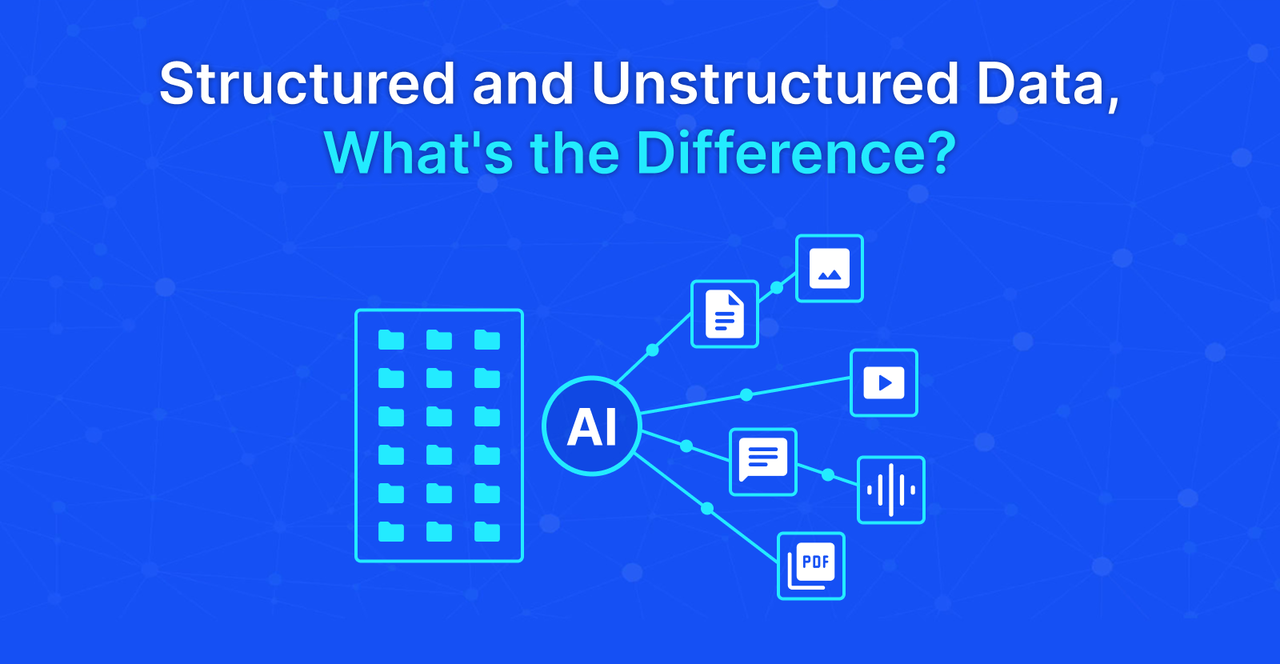
It is a long-known data analytics industry fact that up to 80-90% of all new enterprise data is unstructured. But what does it mean when data is unstructured, and how can enterprises go about finally tackling one of data's biggest unanswered questions?
Thankfully, with the AI era, we're finally making headway in bridging the gap between structured and unstructured data, and thereby unlocking that previously unreachable treasure trove. The ability to analyze both structured and unstructured data simultaneously for enterprises could be transformational, with benefits ranging from improved retention to personalization at scale.
ThinkingAI's Agentic Engine, which can deploy specialized AI agents that can monitor, report, and act on a company's live product environment, is also able to collect unstructured data in real-time, making it one of the best tools for enterprises looking to reach the next level of data intelligence.
What's the Difference Between Structured and Unstructured Data?
The history of data intelligence and analytics lives on spreadsheets. Structured data is found in rows and columns with defined schema that's instantly queryable with Structured Query Language (SQL). Once structured, data can be quickly analyzed, organized, and can deliver precise insights.
However, the scope of structured data can be narrow as it exists within the confines of your designed system. It tracks what you want it to track, but nothing more.
Unstructured data, by contrast, exists without a fixed format. This is data that can be gleaned from customer reviews, social media posts, and recorded meeting notes. Because of its freeform nature, unstructured data cannot be directly queried without analysts first extracting meaning from it. However, unstructured data has context that can be missing from structured data, making it the "wh" to structured data's "what" when analyzing a specific business outcome.
How Structured Data and Unstructured Data Are Tracked Today
Modern enterprises employ a dual track solution to bridging structured data and unstructured data. Business Intelligence teams work on the structured data side, creating charts and graphs that monitor behaviors, trends, KPIs, through dashboards and charts in order to extract meaning.
On the other side, are customer success teams and community managers who sift through support tickets and social media sentiment, to create reports that can measure the temperature of customers and partners and create context around the results. Unstructured data is also gathered from sales call recordings, product reviews, NPS responses, contract documents, and more.
Together, these two teams can create a functional whole in theory, but often do not because multimodal analytics has only recently gained traction within enterprises. Most enterprises do not bridge their BI teams and CS teams in a way that can create a unified picture of the customer, as these organizations typically engage with different arms of a business, and their findings are usually not synthesized into a coherent report.
How ThinkingAI's AI Agents Solve The Problem of Unstructured Data
ThinkingAI's AI agents are specialized operators that can detect changes in a real-time data environment. Whether that's a spike in churn or failing to convert users from a trial to a subscription, Agentic Engine's AI agents are custom-built to not only notice these trends and insights, but to act on them as well by pushing campaigns and A/B tests, even without human intervention.
But what separates Agentic Engine from its competitors is its ability to combine behavioral data, user feedback, community reviews, and internal knowledge bases, all examples of unstructured data, to provide Agents with the full context around an event in order to make the best decisions.
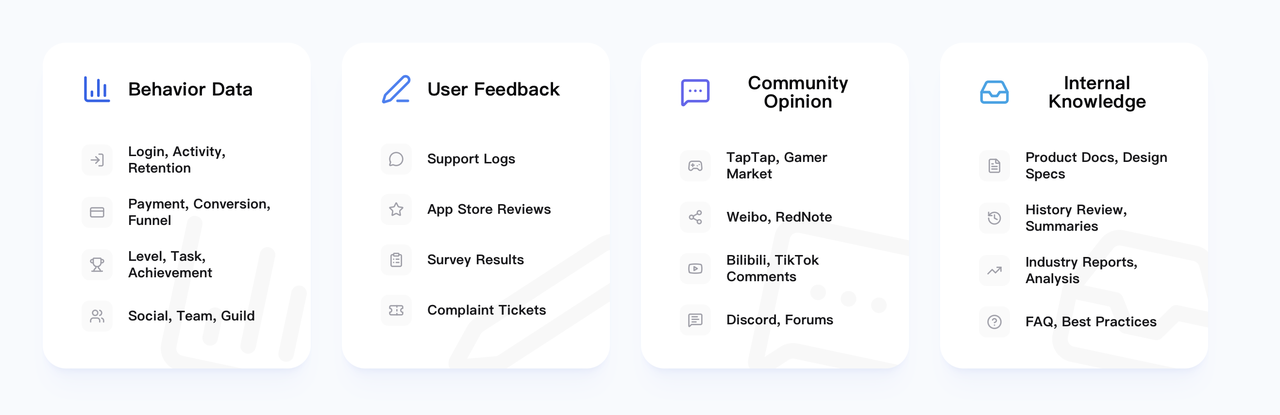
Agentic Engine is able to do this because it allows users to seamlessly connect SDK behavior data, support feedback, community opinions, and internal documentation. Semantic standards can be unified for heterogeneous data, which turns unstructured text into context for Agentic Engine's AI agents.
The result is an analytics agent that acts on both structured and unstructured data. Or in other words, an AI agent that understands the insights from both a data intelligence perspective and customer success perspective and combines the two into total 360-degree context that makes decisions not just based on what happened, but why something happened.
Got Unstructured Data? Try Agentic Engine to Unlock Its Full Potential
Agentic Engine is able to take unstructured data and make it analytically accessible at scale. This untapped value is only now becoming a usable resource for enterprises thanks to our AI agents which have the design and skills to gain total context around your entire business. Book a demo with one of our specialists today to see how Agentic Engine can turn your unstructured data into actionable insights.