
A 39.2% jump in ad impressions looked like a good week for one casual match-3 game, until next-day retention came in 7.5 percentage points lower. Mobile ad monetization runs on that tension. More ads bring more revenue and cost some players, and how many depends on who the players are. This game moved from one ad setup for everyone to a separate strategy for each of four player groups, and the first fixes landed on a single group.
Why mobile ad monetization is a balancing act
An ad-funded game has three levers:
- Frequency: how often a player sees an ad.
- Placement: when the ad appears, for example between levels, on the results page or as a pop-up in the lobby.
- Reward content: what the player gets for watching, such as items, currency or a revive.
Players differ in how much of each they will accept. Some watch 5 rewarded videos without complaint. Others uninstall after 2. A between-level ad can feel natural to one player and a lobby pop-up can end another player's session.
One configuration for everyone misses in both directions. Players who would accept more ads see too few, and players who accept few see too many. Any ad monetization strategy that ignores those differences is tuning for an average player who doesn't exist.
Why the imbalance shows up late
Most teams track impressions and retention as two separate lines. When impressions rise, the first read is that the target was hit. Retention gets a look days later, once the drop is visible.
The usual fix is a rollback. Impressions fall again, another configuration goes into testing and the cycle repeats. Testing frequency, placement and rewards one after another takes a month or two.
Segmenting players adds its own wait. Player-level revenue from ad networks is hard to get, so the team asks the data team for segments and waits for them. By the time the groups arrive, some of the affected players have left.
A match-3 game's Monday morning
The game earned all of its revenue from in-app advertising, with no in-app purchases. Rounds lasted 3 to 5 minutes. Ads were mostly rewarded video, plus interstitials on the results page and in the lobby. A two-person operations team ran both the ad setup and paid user acquisition.
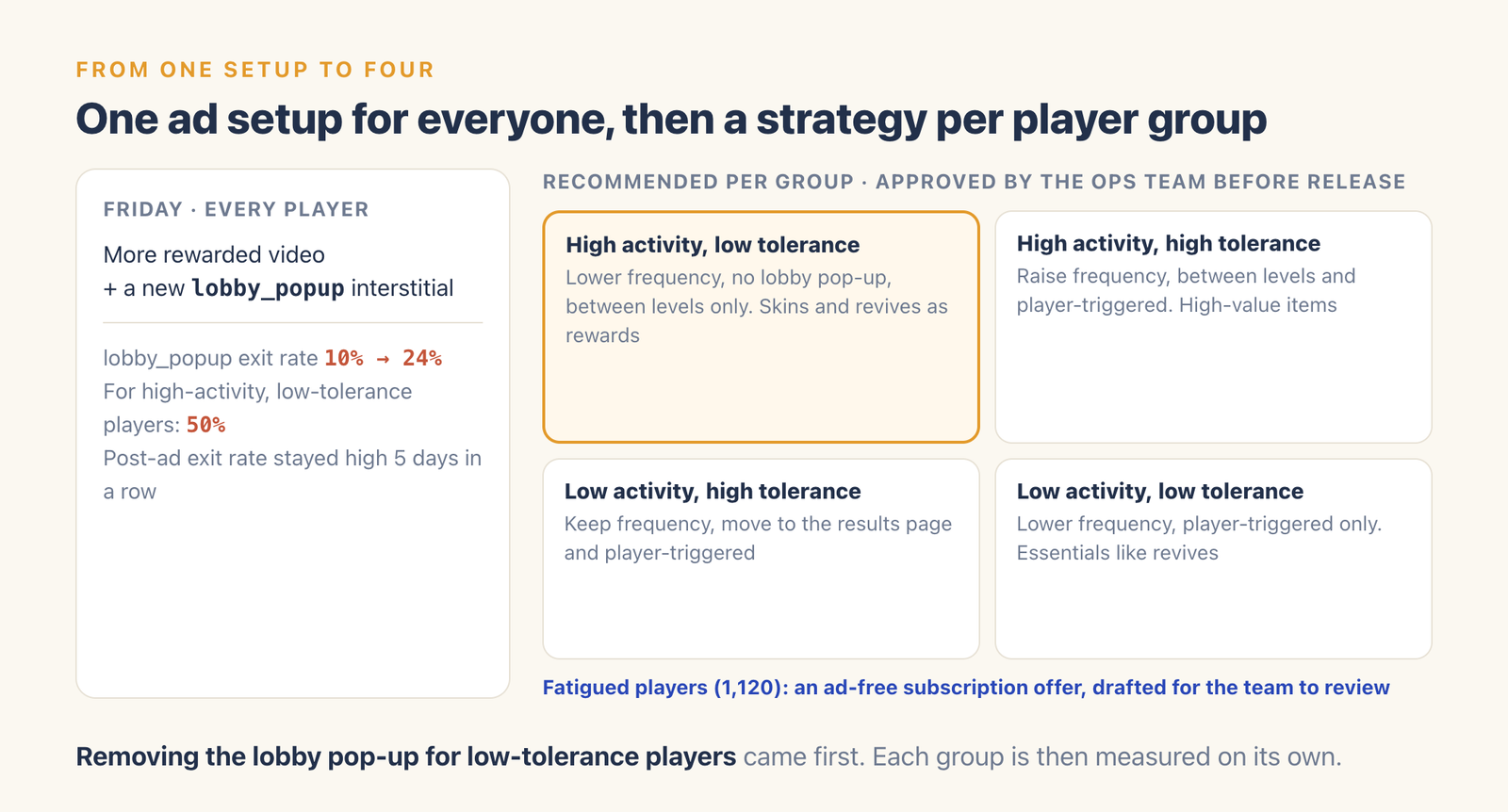
On Friday, to reach the month's impression target, the team raised rewarded-video frequency and added an interstitial in the lobby. The change went to every player.
By Monday morning a scheduled check had already run. It compared ad impressions with D1 retention, the share of players who come back the next day, and posted an alert to the team's chat channel. Impressions were up sharply, D1 retention was down and more players were leaving the game right after an ad. The team adjusted the setup that day. Later in the week the team asked for a full review comparing Monday to Thursday with the same days a week earlier, noting that Thursday's data was still incomplete.
| Metric | This week, Mon-Thu | Last week, Mon-Thu | Change |
|---|---|---|---|
| Ad impressions | 183,200 | 131,600 | +39.2% |
| D1 retention | 54.3% | 61.8% | -7.5 pp |
The average hid a recovery. Daily D1 retention went from 48.1% on Monday to 58.2% on Wednesday, after the adjustment. The timing made the Friday change the main suspect. The open questions were which players it hurt and which lever did the damage.
Four player groups, three levers
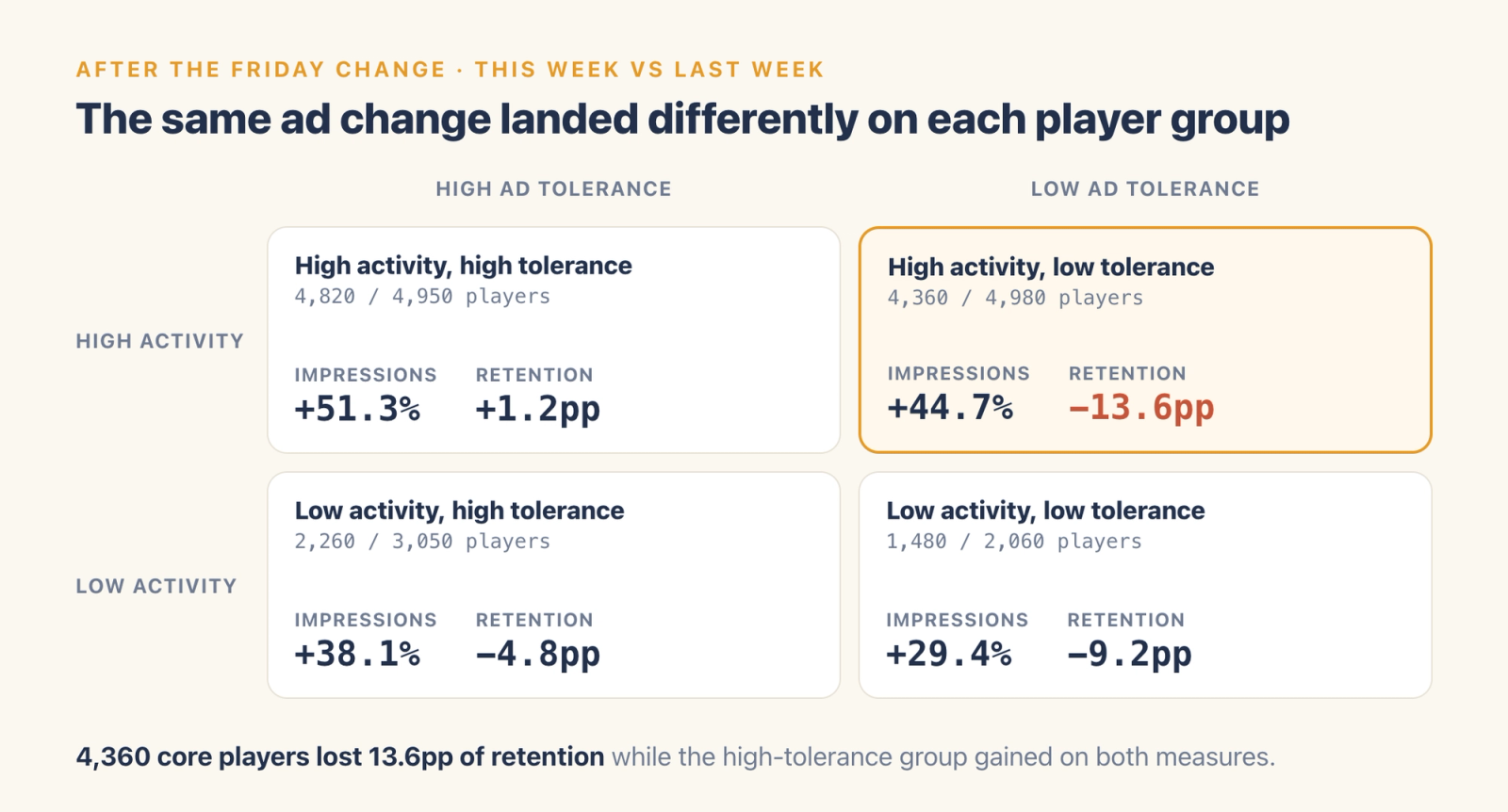
The review split players by activity and ad tolerance, using behavior the game already tracked, such as level progress, ad impressions and item usage. High-tolerance players kept playing as ads added up, and low-tolerance players left. No player-level revenue from ad networks was needed. TW/LW below means this week over last week.
| Player group | Players TW/LW | Impressions | D1 retention |
|---|---|---|---|
| High activity, high tolerance | 4,820 / 4,950 | +51.3% | +1.2 pp |
| High activity, low tolerance | 4,360 / 4,980 | +44.7% | -13.6 pp |
| Low activity, high tolerance | 2,260 / 3,050 | +38.1% | -4.8 pp |
| Low activity, low tolerance | 1,480 / 2,060 | +29.4% | -9.2 pp |
The high-activity, low-tolerance group carried the loss. Its 4,360 players were 33.7% of active players who saw ads. Their impressions rose 44.7% and their retention fell 13.6 points. They play often, so they are the players a game can least afford to lose. The high-activity, high-tolerance group gained on both measures.
Each lever was then read on its own.
- Frequency went from 3.1 to 5.2 ads per player. The high-tolerance, high-activity group held 88% retention at 6.1 ads per player, while high-activity, low-tolerance players fell from 57% to 43% at 4.8.
- Placement gave the sharpest signal. Lobby pop-up impressions rose 412.8% and the share of players who quit the game right after that ad went from 10% to 24%. For high-activity, low-tolerance players it reached 50%. The other placements stayed roughly stable.
- Reward content grew across every reward type with a steady mix and no single outlier, so the team looked at frequency and placement first.
The review also checked for ad fatigue, defined as a post-ad exit rate that stays elevated for three days or more. Before the change it sat at 5% to 7%. From Friday it jumped to 14% to 16%, nearly three times the earlier level, stayed elevated for five straight days and started falling after Monday's adjustment. 1,120 players met the fatigue definition, 730 of them in the high-activity, low-tolerance group.
The pattern was a combination. Higher frequency sent more players to a placement that was already driving them away, which is why neither chart explained the drop on its own.
A strategy per player group
The analysis drafted one configuration per group, and the operations team reviewed each one before it went live.
- High activity, low tolerance: lower frequency, no lobby pop-up, ads between levels only. Rewards with high value per view, such as limited skins and revives, so fewer ads still earn.
- High activity, high tolerance: raise frequency and add player-triggered placements next to between-level ads. Use high-value items such as power-ups and level unlocks.
- Low activity, high tolerance: keep frequency, move ads to the results page and player-triggered moments.
- Low activity, low tolerance: lower frequency and keep only player-triggered ads, with rewards like revives that give a player a reason to opt in.
For the 1,120 players showing fatigue, the team prepared an ad-free subscription offer. The goal was to keep those players, with revenue a secondary concern.
The four strategies ran at the same time, each measured on its own impressions, retention, post-ad exit rate and reward opt-in. Nobody had to wait for one group's test to finish before starting the next, and the whole player base never got another blanket change.
Running mobile ad monetization as a weekly loop
The loop starts with impressions and retention on one view, and an alert only when they move apart. Ordinary movement in one metric waits for the weekly review.
- Group players by activity and ad tolerance from in-game behavior.
- Read frequency, placement and reward content within each group.
- Find the group carrying the retention loss or the unused ad capacity.
- Draft a change for that group and have the operations team approve it.
- Measure each group on its own metrics, then repeat.
The weekly review in this case began as a plain-language request covering four things. Those were the trend against last week, the group that is slipping, the three levers and any sign of fatigue. Judgment still sits with the team, which decides whether a drop is real, which lever to change and when to stop.
All of this depends on clean events. Ad shows, closes, reward completions, placements and post-ad exits need consistent definitions. If the exit event breaks, fatigue simply disappears from the data.
Where ThinkingAI fits
In ThinkingAI, agents run the scheduled check and watch impressions and retention together. When the two diverge, they group players from in-game behavior and break the change down by lever. Each group then gets a drafted strategy, and the operations team decides what ships. Engage carries out the approved per-group tasks, journeys and A/B tests.
This article is one use case pulled out of the Agentic Engine white paper, where ad monetization optimization is chapter 13. The chapter carries what a blog post has to leave out: the event definitions, the tolerance curves for each lever, the per-group targets and exit conditions, and how the results were validated.
Fourteen chapters cover the same ground for user acquisition, live operations, monetization, data engineering, and player support teams. Every one of them keeps a person at the approval step.