
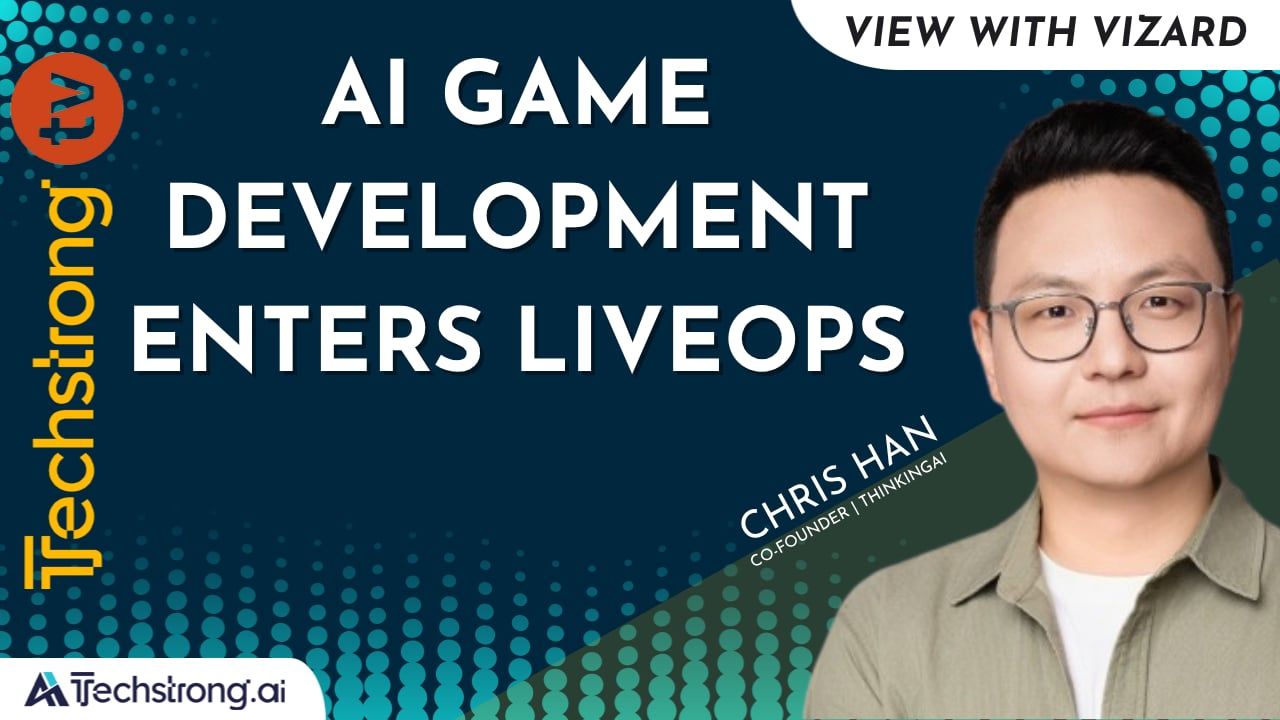
Our co-founder Chris Han joined Mike Vizard on Techstrong TV’s AI Leadership Insights on September 9, 2026. The conversation started from a demo that had just gone around the industry, a tool that turns a handful of prompts into a playable game, and went to the question we spend our days on: once anyone can make a game, what happens to the people who have to run one?
Making a Game Gets Cheaper. Running One Does Not.
Han’s answer was that prompt based game creation is real, and that it changes the front of the process rather than the whole of it. He made the point with his own household. His ten year old son has limited screen time, so Han prompted a model to build him a game, and the boy sat with it for a long stretch. Anyone can be a game developer now. What separates the studios that last is what they do in the months after a game ships.
Vizard pushed on scale: a studio that supports a dozen live titles today could be supporting hundreds. Han agreed that is the direction, and said the load moves with it. A game that was cheap to build still has to be operated, and the operating does not get cheaper because the building did.
Why the Data Layer Comes First
Han has spent more than a decade in mobile game analytics, and his position is that more games raise the value of the data layer rather than lowering it. Before an agent can help run a live game, it needs to know what players are doing: behavior, acquisition, monetization, and how each of those changes by cohort.
He was concrete about why cohorts matter. Inside a single title with millions of daily players, the audience is not one audience. Some players are waiting for new weapons. Some care about outfits. Some are there for the skills and the role they are building. Feeding all of them the same content is the easiest way to lose most of them.
He also pointed at where new games are coming from. Casual has been booming for the last two years, with a lot of the creative energy coming out of markets such as Turkey and Vietnam. The learning curve is low, which brings in players who never considered themselves gamers.
The Window to Act Is Shorter Than in Other Industries
This is the part of the interview closest to what we build. In most industries a team can sit with a finding, socialize it, and act next quarter. Han’s argument is that games do not grant that time.
For games, the time window is so short. Once we get the insights, we need to act on them right away.
Players who are losing interest are gone before the analysis is finished. So the bottleneck is rarely the finding. It is building the segments, the offers and the journey, and getting them live while the player is still there. Han called that the pain point directly, and said it is the reason game operations are harder than the comparable job in most other industries.
AI Inside the Game Is a Separate Question
Asked whether AI belongs inside games, Han separated two things that often get argued as one. Players want to play people, and that is not in doubt. But matchmaking is a real weakness in a lot of live games, and when the system cannot put you against someone at your level the experience suffers whether or not a human is on the other side. He thinks AI opponents can close that gap better than current matching does.
Tools, Then Process, Then Culture
Asked what the industry is not talking about enough, Han went past tooling. His view is that a tool is the first step and the smallest one, and that adopting agents seriously means changing two more things after it.
The second is process. If agents are doing a share of the execution, the workflow that was designed around people doing all of it no longer describes what happens. The third, and the one he thinks is hardest, is culture. A manager’s job used to be organizing how people work with each other. With agents in the process it becomes organizing how people work with agents, and how agents work with each other.
On where people stay, he was specific, and it matches how we build. A person sets the goals and the targets at the start. A large share of the execution can move to agents. The end of the loop comes back to a person deciding what is good and what is not, because judging whether a game is any good is still human work.
This interview was produced by Techstrong TV for the AI Leadership Insights series, hosted by Mike Vizard. Watch the original on Techstrong TV.
Share