
Across more than 1,500 companies, the most common complaint about in-house AI is that it starts strong and then drifts. Answers are sharp at launch, but a month or two later the definitions get muddy and the model starts to miss. People stop trusting it and go back to asking a colleague. The problem usually is not the model. It is the knowledge feeding it: wikis, CRM records, and scanned PDFs piled together, redundant, mis-versioned, and inconsistently named. The Enterprise Knowledge Base is the knowledge layer for Agentic Engine, giving agents high-quality, traceable knowledge to work from.
Why strong AI still misses your business
A general model knows a lot in general, but it does not know how your metrics are defined or what your goals are, so it gives generic answers when you need expert ones. Most companies have plenty of data and very little knowledge. Raw warehouse data fed straight to a model is low signal, invites hallucinations, and wastes the context window. Knowledge an agent can actually use is structured, carries context, and supports reasoning.
Built for agents, not just people
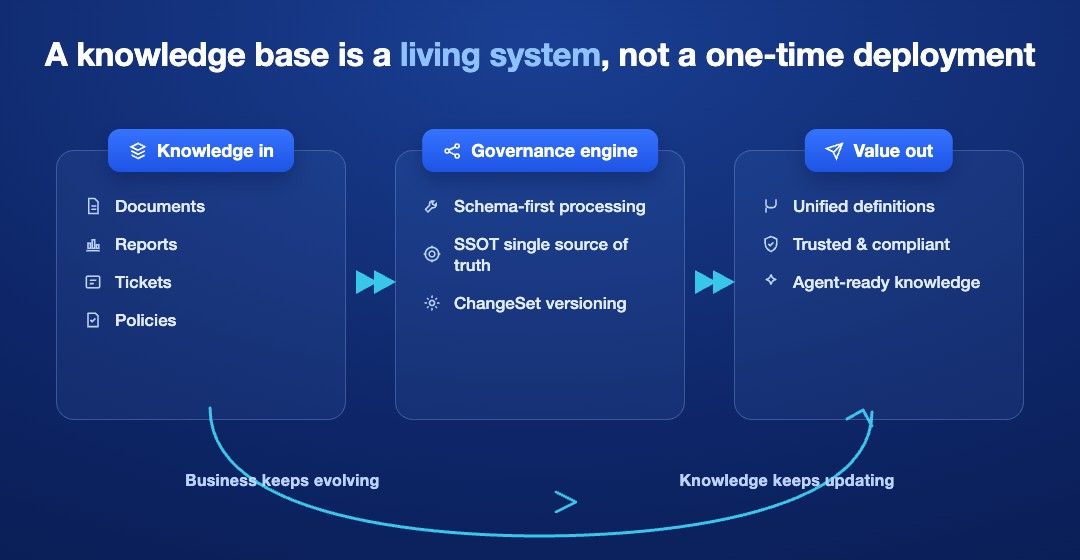
Traditional knowledge bases are written for humans, who can skim a title and fill in the gaps. Agents cannot. They match keywords and cannot tell which version is current or which definition is right. A knowledge base also needs to stay alive rather than ship once and rot. Ours compiles knowledge into an agent-ready form that is structured, linked, and versioned, so an agent can call it directly.
How it works
It connects to your existing documents and reports without disturbing your warehouse, then uses a schema-first approach to turn unstructured files into an entity graph. Knowledge is served through one interface, every change is tracked so it stays auditable and reversible, and a single source of truth means one definition per concept across the whole system. One set of knowledge serves every agent.
Proven across three workflows
We have closed the loop in three common, easy-to-verify places. In support, agents pull from product docs, past tickets, and policy changes and cite the right policy instead of repeating a canned answer. In Text-to-SQL, one definition per metric means the same question returns the same numbers across teams. In analysis, reports come with live data, the logic behind them, and where each number came from. All three share one knowledge base instead of one per use case.
Over ten years and more than 1,500 companies, we have learned that growth comes from data being understood and trusted, not just collected. The Enterprise Knowledge Base is now open for early access.
Share