

A global social company, and a fast-growing app
Chizi City is a social app company founded in 2009 that began expanding abroad in 2013 and went public in Hong Kong in 2019. Its family of apps, including MICO, YoHo, and Yumy, has reached more than 13 billion users across over 200 countries.
Yumy is its one-to-one video matching and chat app. The product is built around a "10-second" match. A user has 10 seconds to decide whether they feel a spark with the person they are matched with, and only when both sides feel it does the video call continue. Within a year of launch, Yumy passed 50 million downloads, and it turned a gross profit in the first half of the year.
Growing in competitive markets
Yumy focuses on high-ROI regions with strong internet penetration and payment behavior, starting in North America, Europe, and the Middle East. These are large, valuable markets, and the competition keeps growing.
The team treats data as the way it makes decisions in these markets, not a report it reads after the fact. The hard part is knowing what to watch and when. Tracking everything equally, all the time, tells you very little.
Changing what you measure as the product grows
Early on, when the goal is building an audience, the team watches retention at day two and day seven, average session length, and how often people open the app. As the product matures and the goal shifts to value, attention moves to who pays, how often they pay, and what they come back for.
The principle is simple. Change what you measure as the product grows, rather than tracking everything at the same weight forever.
Looking past the averages
Aggregate numbers only go so far. To understand why a metric moved, the team studies behavior paths: what people do the first time they open the app, what happens right before a first purchase, and what tends to come before a user drops off. It also looks at content preferences by region and language to tune recommendations.
Two signals get special attention. When retention swings by more than 20 percent, the team digs in right away, because it usually points to a gap in the core experience. When relationship conversion, measured through follows and friend requests, swings by more than 10 percent, they investigate too, because that shift tends to show up in revenue later.
Where ThinkingAI fits in
One example shows how this works. During a stretch of rising spend, the team traced the main driver back to users building more two-way relationships in the app. They shipped a new version that improved relationship conversion, the number of those relationships went up, and overall spend rose along with it.
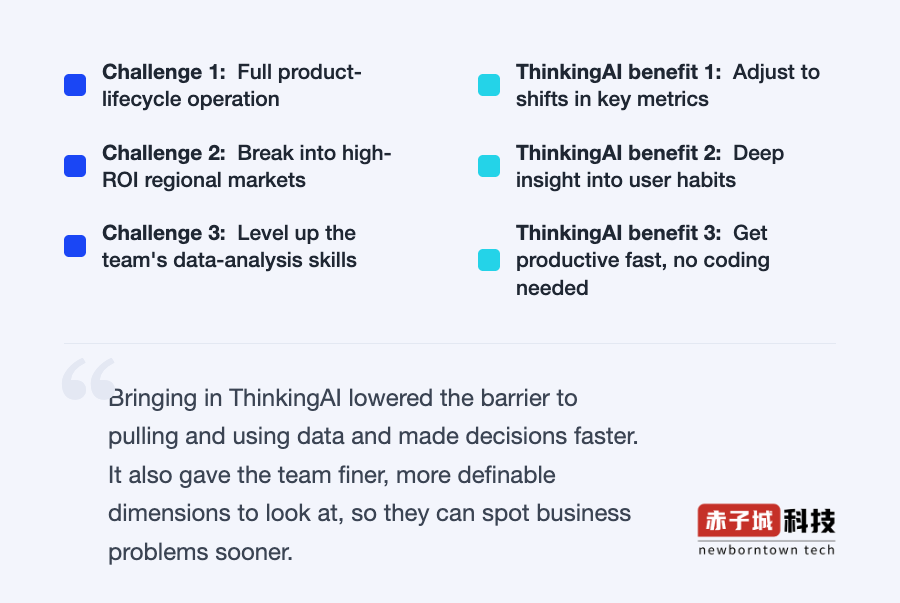
ThinkingAI's analytics platform also lowered the bar for non-technical staff to pull and work with data on their own. Instead of waiting on an analyst, each team can query the data, spot a change, and decide what to do next. Clear visualizations make shifts easy to catch, which gives every department a shared reference for the numbers behind a decision.
The result is a team that reads its users closely at every stage, and acts on what it finds while the signal still matters.