
A casual hit that refused to behave like one
Habby is a global game publisher built by people who came out of some of China's largest internet companies. It runs out of Singapore, Beijing, and Shanghai, and its titles have passed two billion downloads. Its roguelike action game, Archero, launched in May 2019, reached the top ten in more than 50 countries, and held ratings above 80 percent on both the App Store and Google Play.
On the surface, Archero looked like the kind of casual game that rides one big wave of installs and then fades. The data said otherwise. Revenue grew fast in year one, then dipped in year two. At the same time, the cost to acquire players was climbing tens of times over as the audience shifted from casual toward mid-core and hardcore. A single install wave was never going to carry a game like this. Habby decided to run Archero as a long-term service instead.
Why the old playbook fell short
The traditional casual approach, buy a burst of installs and cash the early revenue, does not hold up over years. Many Archero players were new to deeper progression systems, so pushing complex mechanics at them too early would only lose them. The team needed to know, in the moment, when and how to introduce more depth. Without a live read on what players were actually doing, that timing is guesswork.
Reading players, then acting on what they showed
Habby used ThinkingAI's analytics platform to get real-time, multi-dimensional views of player behavior, and to put that data within reach of the people making live decisions. Three threads of work came out of it.
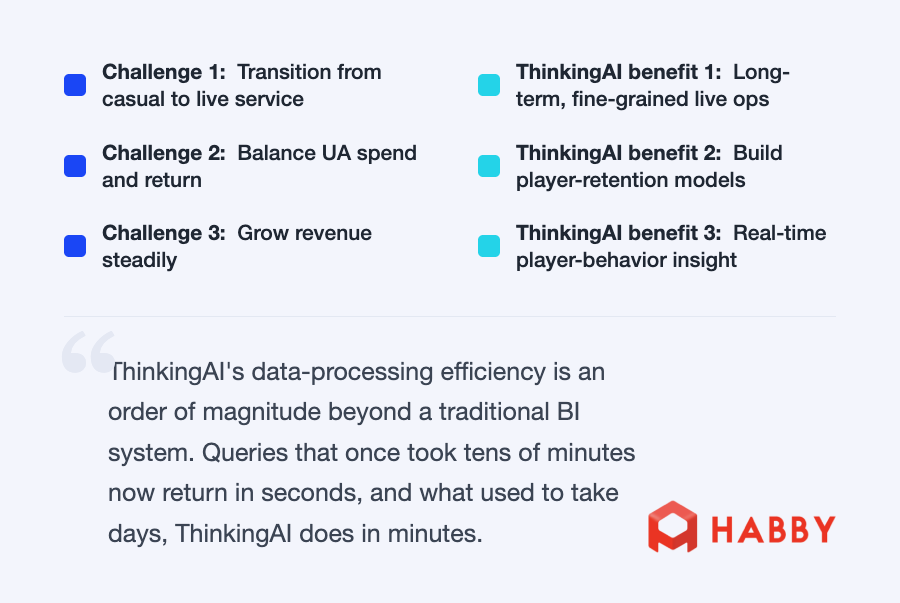
Pacing the progression. The team designed Archero to open with a light experience, ads and a stamina system, then layer in more depth over time: gear, hero leveling, and progression systems aimed at players ready for a heavier experience. Because many players were new to that kind of progression, Habby leaned on A/B testing and behavioral analysis to decide when and how each feature showed up. Meet players where they are first, then lead them somewhere new.
Building monetization around perceived value. Most paying players spend small, with the typical ceiling around $4.99. That makes perceived value matter more than a big headline offer. Habby added a gem system that works across every hero, so a purchase is not locked to one character and each spend feels fairer. The point was to lower the pressure on any single buy.
Tuning event cadence. Limited-time gift packs drove repeat purchases, but an early version released high-value rewards too fast. It pulled future spending forward and pushed revenue down. Habby tied rewards to chapter progress, so players earned them by staying active, and moved the cadence from monthly to every two weeks. Activity rose and long-term spending stayed healthy.
The whale who spent until 2 a.m.
The clearest example of what detail-level data buys you came from a single high-spending player. Over four hours, this player put about $14,000 into the game. The purchase history showed more than 150 separate charges running past 2 a.m. Most were the largest single tier available, about $90 each. A few were tiny, under a dollar, and looked like slips made by a tired thumb late at night.
That kind of read only comes from real-time, purchase-level data. A cohort dashboard would have rolled this player into an average and shown a healthy revenue day. ThinkingAI let Habby follow one player, purchase by purchase, as it happened, the kind of read a general analytics dashboard flattens away. It pointed to concrete changes. Habby opened a dedicated channel for its highest spenders, with VIP support handling top-ups and adding perks. It also reordered the price tiers in the store so that reaching the highest tier no longer meant paging past everything else. The changes were small. The lift to the top players' experience was not.
What live operations looks like when data is within reach
None of this is one big move. It is a series of small, evidence-backed adjustments made over two-plus years of sustained live operations, across 2B+ downloads and a top-10 spot in 50+ countries. The through line is long-term retention. Chasing short-term revenue at the cost of the player base is the wrong trade. Reading player behavior closely, then acting on it, is what keeps a game growing well past the point where a casual hit usually flattens out.