

PUMP started Korea's first shared personal mobility service. Today it runs e-scooters and e-bikes in major cities across the country under the Kickgoing and XingXing brands, and offers several mobility services in one app. Six months after adopting ThinkingAI, the company had cut its marketing time by about a third and raised market share by 10% in the regions where it tested new campaigns.
Ride patterns vary by district
As our service expanded across the country, travel patterns varied more by time of day, region and rider group. Usage could differ sharply from one district to another, even within the same city. In a fast-changing mobility market, responding accurately to demand matters as much as providing rides. Quick decisions and action based on data have become essential.
Planning, operations and marketing all needed data, but PUMP's previous solution had limits. People without analytics training struggled to access the data, and few staff were skilled in SQL or complex statistics. Building a marketing plan for each region was hard as well.
Why PUMP chose ThinkingAI
Jeongyun Lee, PUMP's marketing team lead, gives three reasons. The first was access for everyone. "The first strength was that people in any role could get to the data easily and analyze it themselves," Lee says. Few people at PUMP wrote SQL, and ThinkingAI gave them an intuitive drag-and-drop interface.
The second was an interface fully in Korean, which cut the learning curve. The third was onboarding. ThinkingAI's team learned how PUMP's data was structured and gave training built around it, so people could put the tool to work right away.
Finding a region with unusually few round trips
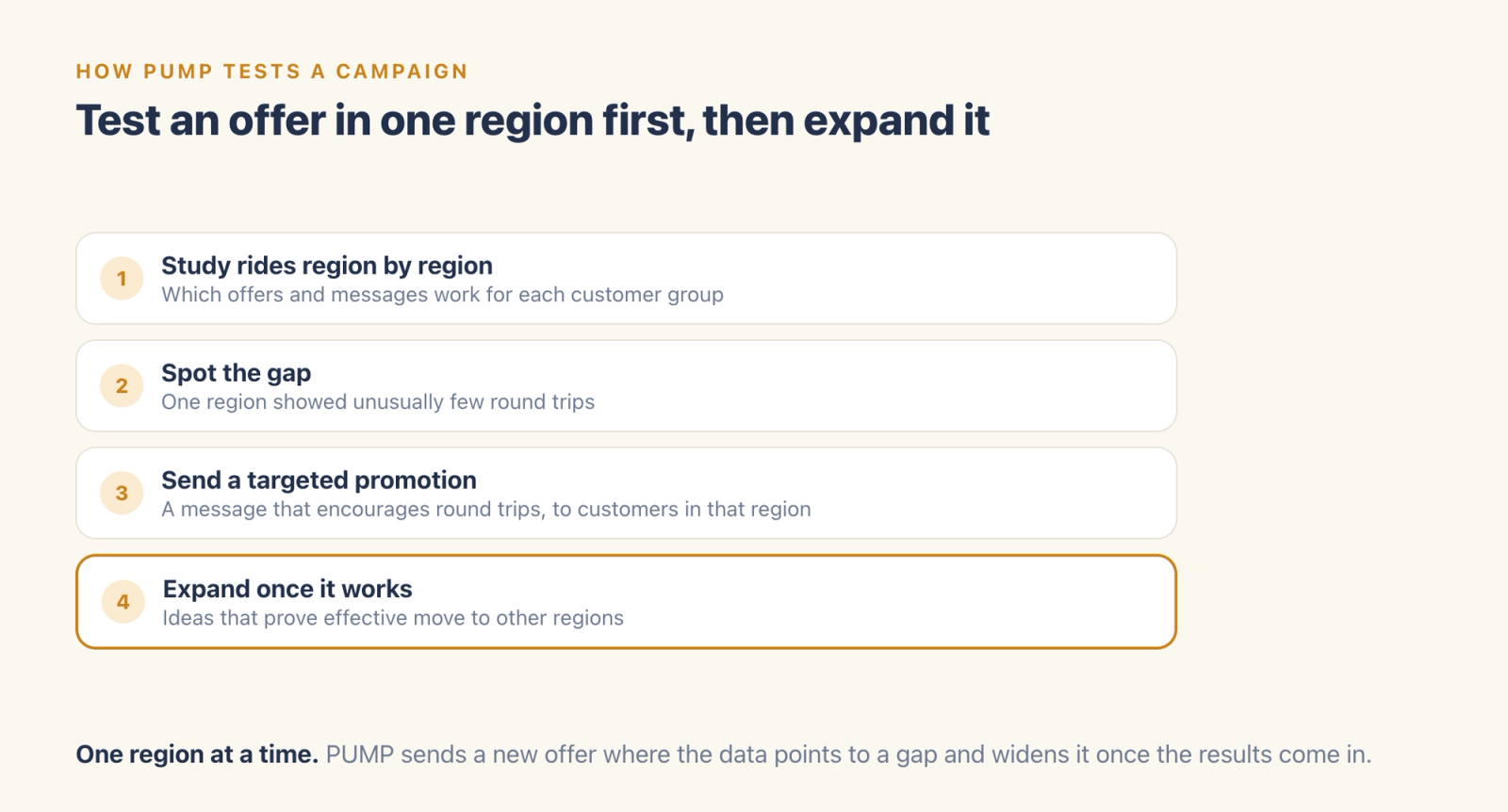
With ThinkingAI in place, PUMP studied rider behavior region by region to learn which offers worked for each customer group. The team also looked at how different offers and messages landed with customers and how responses varied.
In one region, the data showed unusually few round trips. The team created a promotion message that encouraged round trips and sent it to customers there. PUMP tests an idea in one region first and expands it to others once it proves effective.
Support that solves problems with you
What stood out most for Lee was how the ThinkingAI team helped. "The biggest advantage was fast support and quick feedback," Lee says. "They went beyond technical answers and shared how they would handle each case and what they thought, so it felt like we were solving problems together."
Even a good tool has limited value when it is hard to fit into daily operations. ThinkingAI was a partner that helped us a great deal with that.
Results after six months
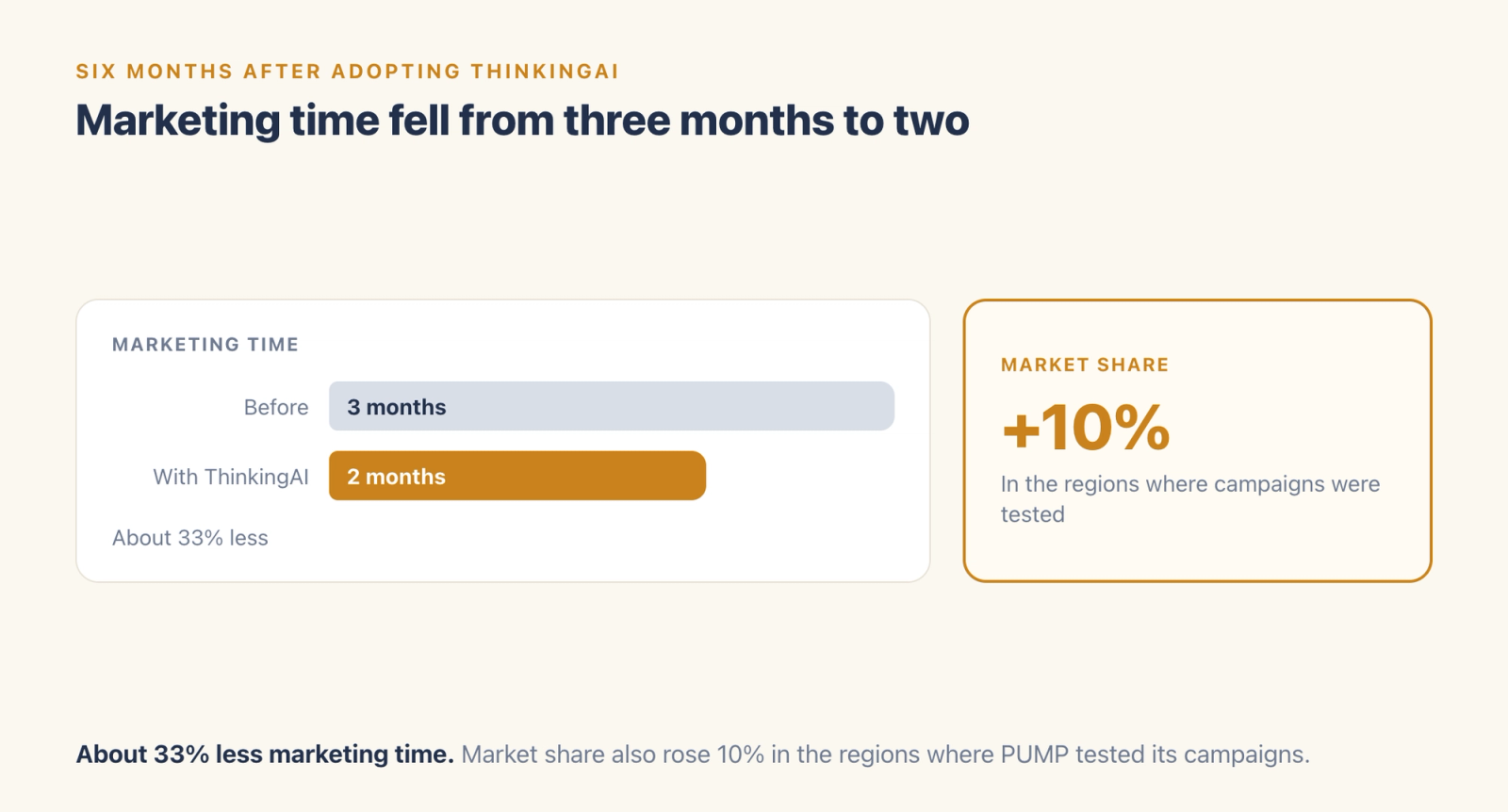
When PUMP tested ways to increase rides in a region, the team could quickly see which offers worked. Marketing time went from three months to two, about 33% less, and market share rose 10% in the regions where campaigns were tested.
Marketing, operations and planning now all take part in analysis. The time from analysis to action is shorter too.
Who Lee would recommend it to
Asked which companies should consider ThinkingAI, Lee points to teams without a dedicated data team, where the people doing the work look at the data, analyze it and act on it themselves. It also fits teams that handle data across many departments, and teams where anyone should be able to analyze data and act on it.
For a team that wants to make decisions and act based on data, ThinkingAI is the most practical and sensible option.
“At first we reviewed several solutions, but ThinkingAI clearly stood apart.”