

Team Rhythmicals runs COXETA, a rhythm game in which vertical lanes from the front meet horizontal lanes from the back, so the music feels more three-dimensional. The game has passed 270,000 downloads, offers close to 100 songs and has run collaborations with O2Jam and virtual YouTubers. CEO Juhyuk Park had three goals for the studio's data. The team wanted to catch players who cheat, learn where players have fun and where they leave, and test the right business model for each country.

Catching cheaters for the first time
Before ThinkingAI, the team had no way to analyze data as it came in. Park's team suspected some players were cheating, yet had never caught a single one. With ThinkingAI, the team could count the players holding in-game currency as the numbers changed and spot the ones holding abnormally large amounts. About 10 of those players have now been sanctioned.
Data that sometimes proved the team wrong
Earlier, the team judged where players had fun from its own experience, its own judgment and a few opinions seen online. Once it checked those ideas against live data, some held up. Quite often the results were completely different, or surprising.
Our guesses matched the data some of the time, but quite often the results came out completely different or surprising. Being able to make decisions based on data has been a real advantage.
Selling songs one at a time in the Philippines
On a visit to the Philippines, Park noticed that shoppers often preferred paying a little more per tube for a single tube of toothpaste over buying a discounted five-pack, because the single tube cost less up front. COXETA mostly sold songs in packs of five. That raised a question. Would players in the Philippines buy more if songs were sold one at a time?
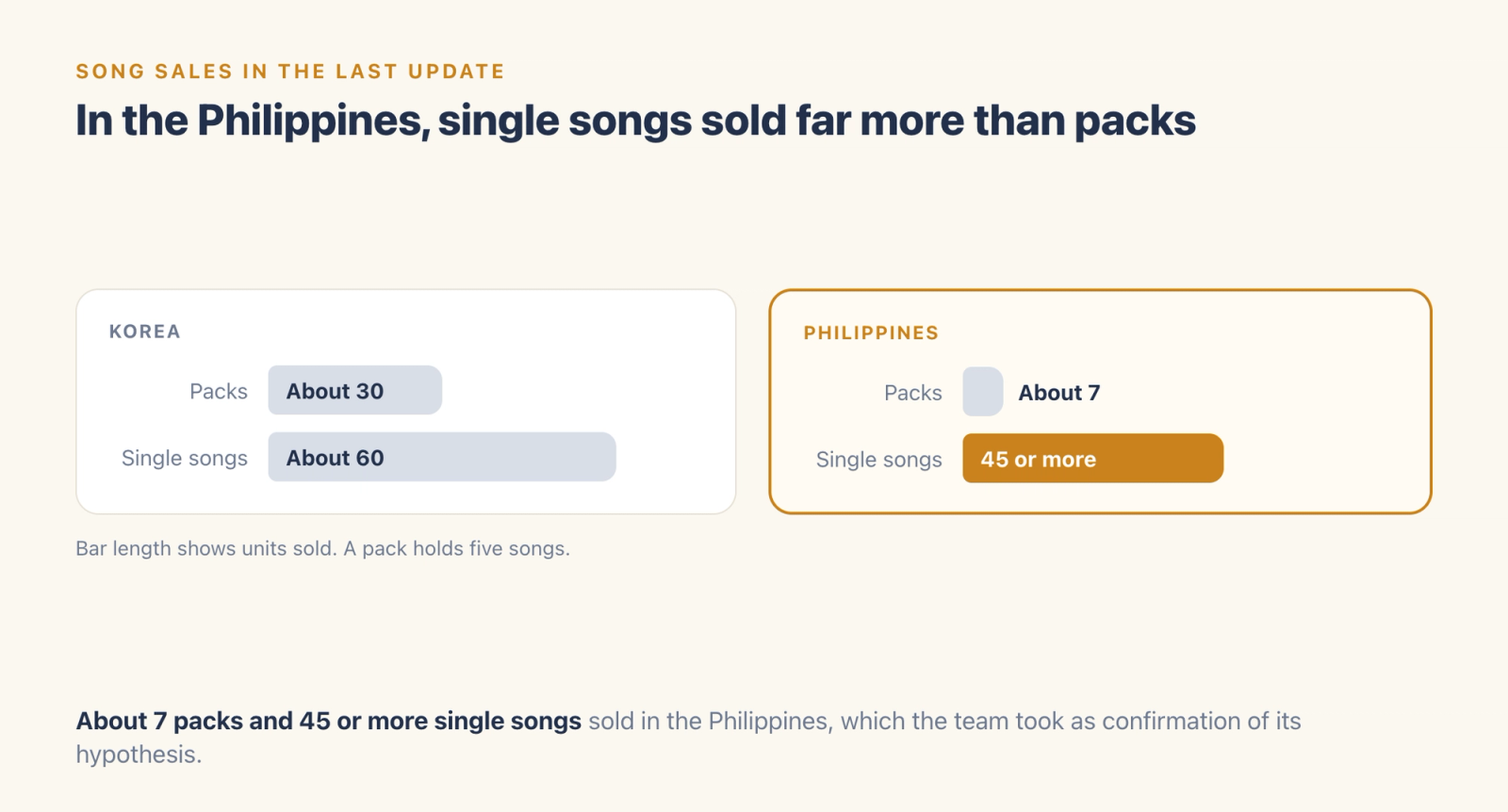
The team tried it in its last update. In Korea, about 30 music packs and 60 single songs sold. In the Philippines, about 7 packs and 45 or more single songs sold. The team took those results as confirmation of its hypothesis and began preparing updates to match.
Why Team Rhythmicals chose ThinkingAI
Above all, it was easy to pick up and easy to use.
Park singled out ease of use. The older statistics tools the team knew required server programming knowledge and were hard to use. ThinkingAI was different. One of the team's app programmers had no server background and still found it easy to add the code that records player actions, and the guide documents were thorough. Park had little experience with statistics or analytics tools and had no real trouble using ThinkingAI either.
Better questions get better answers
Park compares ThinkingAI to an AI chat assistant, where a better question gets a better answer. Ask only for daily active users or how many players keep coming back, and that is what comes back. Ask where players get frustrated and where they have fun, and ThinkingAI can show that data too.
Say a restaurant sells a lot of kimchi stew during the day and rolled omelets at night. With a tool like ThinkingAI, you might see that 90% of the daytime kimchi stew customers are men. You could infer that they want a quick lunch and plan side dishes or special events for them.
“Above all, it was easy to pick up and easy to use.”