

WonderPlanet develops and releases games for players around the world. Crash Fever was named a 2016 Google Play Best Attractive Game and reached 14 million downloads worldwide in 2022. In December 2022, the company adopted ThinkingAI as its shared data analysis platform across the company. We spoke with Norikazu Hiraki, Executive Officer, VPoE (vice president of engineering) and head of the Engineering and Design Management Office, and with Yokoyama, who analyzes data for Crash Fever.
Event tracking started from scratch for each new game
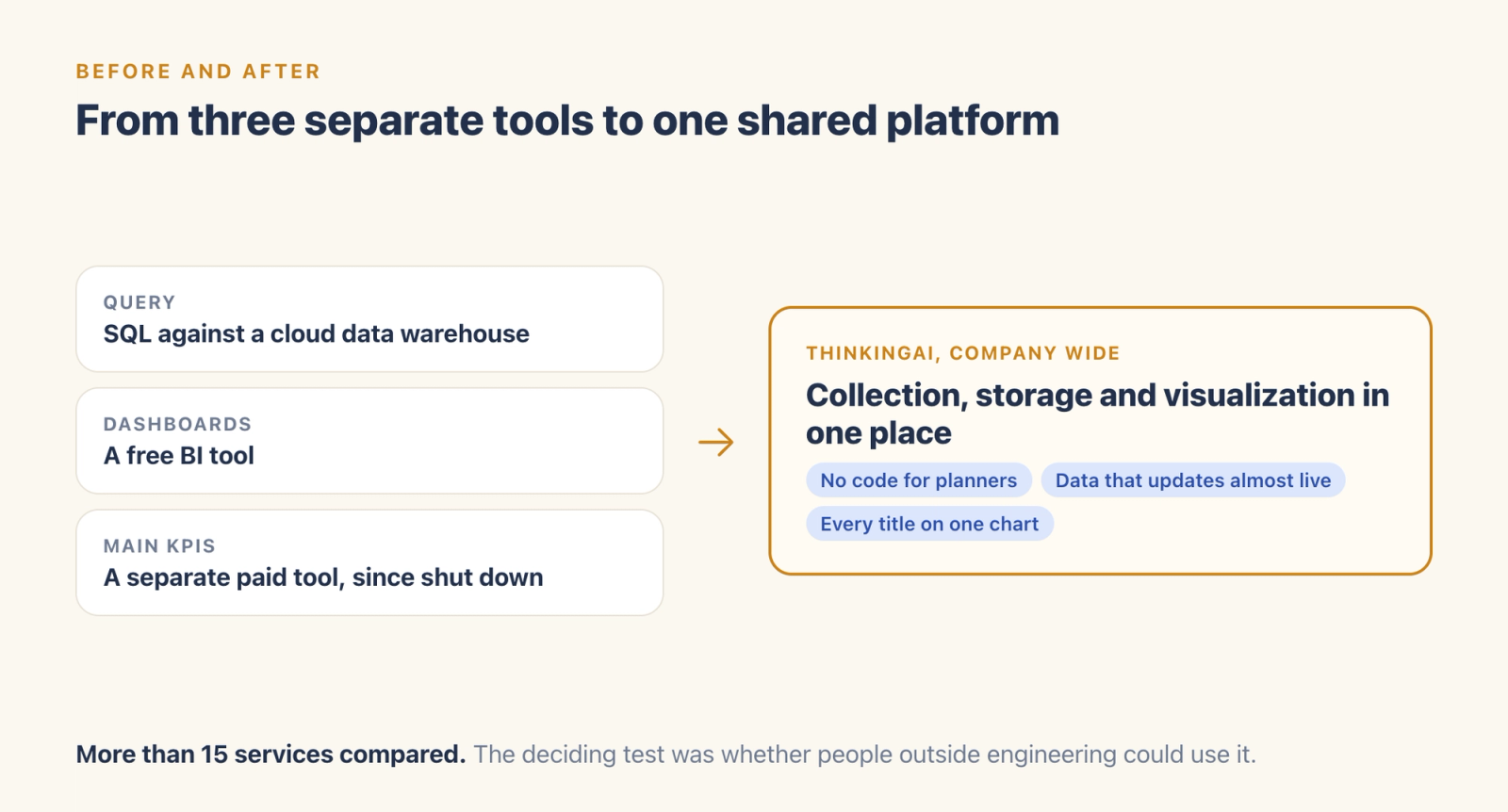
Before ThinkingAI, the team pulled data with SQL from a cloud data warehouse, built dashboards in a free BI tool and tracked its main KPIs in a separate paid tool.
With no standard system across the company, skills and knowledge got lost along the way. The team designed event tracking from scratch for each new product, and the ETL scripts that moved and prepared data went unshared, so they became black boxes when the engineers who wrote them left. When the paid KPI tool shut down, WonderPlanet started looking for a tool that could support wider and more advanced use of data.
A tool people outside engineering could use
We were looking for a standard tool for the whole company, so we were very careful and compared more than 15 services.
Hiraki's most important test was whether people outside engineering could use it. "Data is only part of the picture, but I believe that using it well raises the productivity of the whole company," Hiraki says. "So a tool that anyone could use was essential."

ThinkingAI's product idea was that anyone can be an analyst, and the product felt good to use in hands-on trials. It covers data collection, storage and visualization in one solution, which Hiraki expected to lower operating costs. Data also updates almost as it happens, so the team can see a new campaign's early results right away.
The pricing model appealed to us too. Many other tools charged per user account, which clashed with our wish for everyone to work with data. Tools used alongside a data warehouse could also add charges per query, so people analyze with one eye on cost. They start cutting back on how often they analyze and how much data they use, which defeats the purpose.
Planners now work with the data themselves
Yokoyama saw the change firsthand. Before, a data request from a planner usually meant writing SQL, and each request took time. Many requests were vague, so reports often missed what the planner wanted, and the data had to be pulled again.

With ThinkingAI, analysis needs no code, so planners started working with the data themselves. There is less back and forth and less routine work, and I can spend more time on specialist analysis.
Hiraki sees the same pattern across the company. Planners and producers have also started using dashboards. The old BI tool was hard to use, which made rolling it out company-wide difficult. Since ThinkingAI arrived, Hiraki feels that working with data is spreading across the business teams.
Features the team relies on
For revenue earned around the world, Hiraki points to currency and time zone conversion. Converting overseas sales to yen at each day's exchange rate used to take effort, and ThinkingAI now does it automatically. ThinkingAI can also show metrics for every game title on one chart, so differences between titles and progress on company KPIs are easier to see. Cumulative charts take one click.
Yokoyama values the flexibility of the dashboards. The old dashboards needed changes to the source data whenever someone wanted a different view. In ThinkingAI, users can change the date range for a whole dashboard and filter it by specific conditions, so several teams and team members can use the same dashboard.
What comes next
With more time for advanced analysis, Yokoyama planned to dig deeper. Crash Fever had been live for more than seven years, so clustering analysis could compare long-time players with recent newcomers. Flow analysis could show how in-game behavior differs by player segment, and funnel analysis could show where players quit across the game's five tutorial stages. Each of these used to require SQL and now needs no code.
For new games, WonderPlanet planned to design data collection around ThinkingAI from the start and share what works across the company. Existing games were to adopt ThinkingAI gradually, in a way that avoids disrupting current work.
We want to build an environment where anyone can use data, combine the power of data and people to improve our games, and keep creating game experiences that attract players.
“We were looking for a standard tool for the whole company, so we were very careful and compared more than 15 services.”